11 minute read
Online electronic prescriptions: how they work in Italy
Understand electronic prescriptions in Italy: Sistema TS, NRBE, pharmacy checks and the doctor’s role.
DIRECT ANSWER
An online consultation lets an EU-licensed doctor review your case and, if appropriate, issue an electronic prescription; each pharmacy decides whether it can dispense it.
Doctor reply in under 2 hours
Average doctor reply under 2 hours; at night and on public holidays it can take longer, always within 24 hours. A prescription only if appropriate.
EU-licensed doctors
Every case is reviewed by an EU-licensed doctor.
Electronic prescription
Each pharmacy decides whether it can dispense an approved prescription; some do not accept PDF prescriptions.
HOW IT WORKS
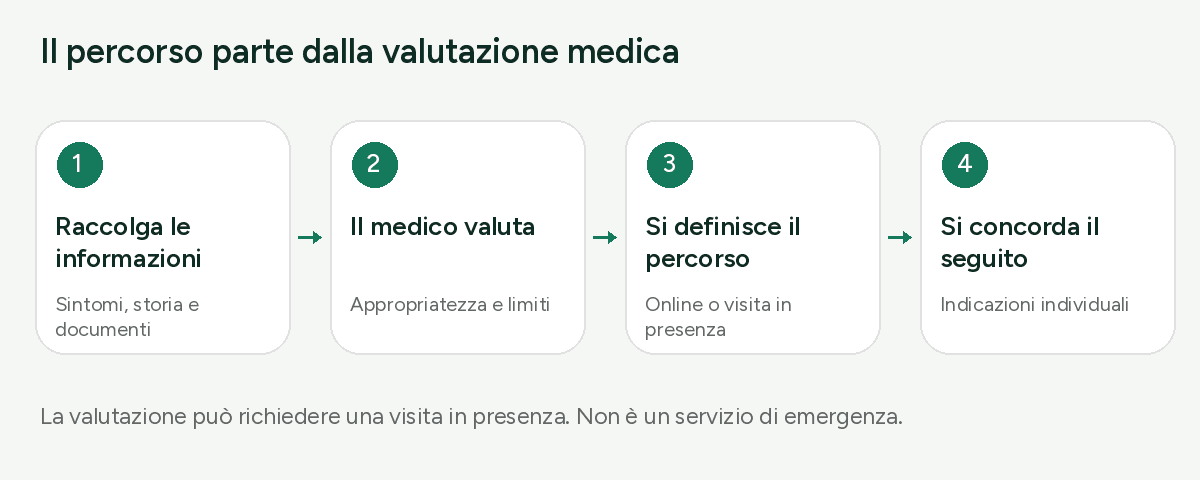
From consultation to collection
- 1
Consultation
Answer a secure medical questionnaire online.
- 2
Doctor reviews
An EU-licensed doctor personally assesses your case.
- 3
Prescription only if appropriate
The doctor replies in under 2 hours on average and issues a prescription only if it is clinically appropriate.
- 4
Collect at the pharmacy you choose
Take an approved prescription to the pharmacy you choose; each pharmacy decides whether it can dispense it.
This guide explains how online electronic prescriptions function in Italy, detailing the national systems and processes involved. It provides adults with the necessary information to understand the journey from a medical consultation to receiving treatment from a pharmacy.
In Italy, national electronic prescriptions and prescriptions issued in another EU country follow different administrative routes. Knowing which document you have helps you prepare for the pharmacist’s checks. Neither an online form nor a digital file alone establishes that a treatment is appropriate or can be dispensed.
Key takeaways
Italy's national platform, Sistema Tessera Sanitaria, manages both public (NRE) and private (NRBE) electronic prescriptions.
A doctor must assess whether a prescription is appropriate; completing an online form does not establish that it is.
Pharmacists use your tax code and a unique prescription number to retrieve and validate the prescription from the central system.
Prescriptions from doctors in other EU countries are valid in Italy but operate under different cross-border regulations.
Understanding Italy's Electronic Prescription System
Dematerialisation records prescription information electronically. The patient may still use a printed reminder to help the pharmacy retrieve the record [1].
The Role of Sistema Tessera Sanitaria (Sistema TS)
Sistema Tessera Sanitaria (Sistema TS) supports the national electronic-prescription workflow. For prescriptions issued through this route, the doctor transmits information to the system and authorised pharmacies retrieve the record. A document produced outside this route is not automatically an NRBE merely because it is digital [2].
Public vs. Private Prescriptions: NRE and NRBE
It is important to distinguish between the two main types of electronic prescriptions in Italy, as they correspond to different funding and access routes.
- NRE (Numero di Ricetta Elettronica): This is the electronic version of the traditional "ricetta rossa" (red prescription). It is used for treatments and services covered by the Servizio Sanitario Nazionale (SSN), Italy's national health service.
- NRBE (Numero di Ricetta Bianca Elettronica): This is the electronic version of the "ricetta bianca" (white prescription). It is used for treatments that are not covered by the SSN and must be paid for privately by the patient [1]. This guide focuses primarily on this private prescription process.
How a Private Electronic Prescription (NRBE) is Created
The process of generating a private electronic prescription involves strict protocols to ensure patient safety and regulatory compliance. It always begins with a professional medical evaluation.
The Doctor's Role and Responsibilities
Doctors enabled to use Sistema TS can generate an NRBE through that system; this administrative access does not replace clinical assessment [3]. The process begins with a consultation, during which the doctor evaluates your symptoms, medical history, and overall health to determine if a prescription-only treatment is appropriate for your condition. A doctor assesses each case and decides whether an online consultation or any treatment is appropriate.
If a prescription is deemed necessary, the doctor securely logs into the Sistema TS portal. They enter the patient's codice fiscale (tax identification number), along with details of the prescribed treatment. Accreditation to the system is separate from the clinical assessment of the patient [3].
What Happens After the Consultation
Once the doctor submits the information, the Sistema TS generates a unique prescription number, the NRBE [2]. The doctor then provides the patient with a promemoria (reminder). This reminder is not the prescription itself but a document containing the essential information needed to retrieve it, including the NRBE number and the patient's codice fiscale. The doctor can provide the reminder in paper or electronic form [3]. The actual prescription now exists securely within the national system, ready to be accessed by a pharmacy.
Using Your Electronic Prescription at the Pharmacy
With your prescription details in hand, the final step is to visit a pharmacy to have the treatment dispensed. The electronic system makes this process straightforward and secure.
Presenting Your Prescription Details
To have your prescription filled, you need to provide the pharmacist with two key pieces of information:
- Your codice fiscale, which is found on your tessera sanitaria (health insurance card).
- The NRBE number from the promemoria your doctor gave you.
Presenting your health card is often the easiest way to provide your codice fiscale. The combination of these two codes allows the pharmacist to locate your specific prescription in the system.
The Pharmacist's Verification Process
The pharmacist retrieves the prescription, checks its validity and the dispensing conditions, and records any dispensing in the system. Whether it can be used again depends on the applicable prescription rules; it is not correct to treat every prescription as single-use. Stock and any need for clarification can also affect dispensing [1].
Preparing for an Online Medical Consultation
To make the most of an online consultation and help the doctor make an accurate assessment, it is helpful to be prepared. A thorough consultation is the foundation of safe and effective care, whether for general health concerns or specific issues related to topics like sexual health or hair growth.
Gathering Your Medical Information
Before your appointment, take a few moments to write down key details about your health. This should include any chronic conditions you have, past surgeries, known allergies, and a list of any medications or supplements you are currently taking. Having this information ready helps the doctor get a complete picture of your health status quickly and accurately.
Finding a Quiet and Private Space
Use a private device and setting when providing health information. Read each question carefully and explain anything you are unsure about. Medical conversations for the service described here take place in the private chat within the patient account; the service should not be assumed to involve a telephone or audiovisual appointment.
Having Your Documents Ready
Keep your identification document (such as your carta d'identità) and your tessera sanitaria nearby. The doctor will need to verify your identity, and your tessera sanitaria contains your codice fiscale, which is essential for issuing an Italian electronic prescription.
Comparison of Prescription Types
The following table summarises the key differences between the main types of prescriptions you may encounter.
| Feature | Private Electronic Prescription (NRBE) | Public Electronic Prescription (NRE) | Cross-Border EU Prescription |
|---|---|---|---|
| Issuing Authority | Accredited doctor in Italy | Doctor affiliated with the SSN in Italy | Licensed doctor in any EU member state |
| Funding | Not charged to the SSN through this prescription | Subject to SSN eligibility and applicable contributions | Payment and possible reimbursement depend on the applicable rules |
| System Used | Italian Sistema TS | Italian Sistema TS | No single interoperable EU system |
| How to Use | Provide NRBE and codice fiscale to pharmacist | Provide NRE and codice fiscale to pharmacist | Check the required format with the pharmacist; a paper copy may be necessary |
| Use abroad | Ask for a copy suitable for cross-border use | Ask for a copy suitable for cross-border use | Destination-country dispensing rules apply [4] |
A 4-Step Guide to the Online Prescription Process
Navigating the online prescription process can be broken down into four simple steps, from consultation to collection.
- Medical Consultation
The process always starts with a consultation. You connect with a doctor who reviews your medical history and discusses your current health concerns. This assessment is crucial for determining if a prescription-only treatment is safe and suitable for you.
- Prescription Issuance
If the doctor concludes that a treatment is appropriate, they will issue a prescription. For prescriptions within the Italian system, the doctor logs into the Sistema TS to generate an NRBE. For cross-border prescriptions, the doctor prepares a prescription with the content required by the EU framework.
- Receiving Your Prescription Details
You will receive the necessary information to access your prescription. For an NRBE, this is the promemoria containing your unique prescription number. For a cross-border prescription, you will typically receive a signed digital document (like a PDF) or instructions to print a paper copy.
- Dispensing at the Pharmacy
You take your prescription details to any pharmacy in Italy. The pharmacist will use the information to verify the prescription,either by accessing the Sistema TS or by validating the details of a cross-border prescription,and decide whether dispensing can proceed.
Prescriptions from Doctors in Other EU Countries
A prescription issued in another EU country can be presented at an Italian pharmacy, but dispensing follows Italian rules and the pharmacist’s checks. Cross-border recognition does not establish product availability or automatic electronic interoperability [4].
Understanding Cross-Border Healthcare
EU rules provide a framework for presenting a prescription in another member state. That does not make a Spanish prescription an Italian NRBE or establish that the pharmacy can dispense it. Check the required format, availability and any payment or reimbursement arrangements before relying on it [4].
For Hi Doctor, a doctor licensed in Spain assesses each case and decides whether an online consultation or any treatment is appropriate. Any prescription is issued in Spain; it is not an Italian Sistema TS/NRBE prescription. Each pharmacy decides whether it can dispense it under the applicable rules, and a paper copy may be needed. If the doctor declines, Hi Doctor refunds the full consultation fee. Medical communication takes place in the in-app private account chat. This service pathway is separate from the Italian electronic-prescription process described above [4, 5].
What's Required and What to Expect
For a cross-border prescription to be valid, it must contain specific information: patient's full name and date of birth; the prescribing doctor's full name, professional qualification, and contact details; the date of issue; and clear details of the prescribed treatment [4].
When you present a cross-border prescription at an Italian pharmacy, the pharmacist assesses dispensing according to Italian laws and regulations. They will verify the prescriber's credentials and the prescription's validity. Be aware that the availability of the specific treatment is not guaranteed, and electronic systems between countries are not always interoperable, which is why a paper copy may be required [4].
When to see a doctor
It is essential to consult a qualified medical professional for any health concerns rather than attempting to self-diagnose. A doctor can provide an accurate diagnosis, recommend the most appropriate course of action, and assess potential benefits, risks and whether treatment is appropriate.
You should schedule a consultation with a doctor if you:
- Experience new, persistent, or worsening symptoms.
- Have questions or concerns about a current treatment or condition.
- Believe you need a prescription-only medicine.
- Require a renewal for an ongoing prescription.
- Need guidance on preventive care or general health matters.
You can connect with medical professionals through services like information about the doctors.
Medical information: this guide does not replace an individual medical assessment.
Sources
COMMON QUESTIONS
Frequently asked questions
No, they are different. A valid Italian electronic prescription (NRBE or NRE) is a record logged in the national Sistema TS, which the pharmacist accesses directly [1, 2]. A simple digital file, such as a PDF, is more likely to be a cross-border prescription or a promemoria (reminder); it does not by itself prove registration in the Italian national system.