Hair growth6 minute read
Anabolic Steroid Hair Loss: Causes, Treatments, and Reversibility
Experiencing hair loss from anabolic steroids? Get an online consultation with an EU-licensed doctor for effective treatments like Finasteride or Minoxidil. Prescription in under 24 hours, valid at any EU pharmacy, for just €45/90 days o…

DIRECT ANSWER
An online consultation lets an EU-licensed doctor review your case and, if appropriate, issue a prescription that is valid across the EU.
Doctor reply in under 2 hours
Average doctor reply under 2 hours; prescription within 24 hours if approved.
EU-licensed doctors
Every case is reviewed by a licensed clinician.
Valid across the EU
Approved prescriptions can be used at any EU pharmacy.
Dealing with hair loss from anabolic steroids? You can get a prescription for effective treatments like Finasteride or Minoxidil online, right here. An EU-licensed doctor reviews your case, and if appropriate, issues a prescription in under 24 hours. The consultation fee is just €45 every 90 days (cancel anytime) or €35 one-off, and your prescription is valid at any pharmacy across the EU. No risk — if the doctor determines treatment is not for you, your payment is refunded automatically.
How it works: get your hair loss treatment prescription in 4 steps
- Fill the online medical questionnaire (2–3 minutes) and pay the consultation fee of €45 every 90 days or €35 one-off.
- A licensed EU doctor reviews your case in private. If the doctor decides the treatment is NOT appropriate, your payment is refunded automatically, so there is no risk.
- If approved, you receive a valid electronic prescription (PDF file) in your Hi-Doctor account and by email within 24 hours.
- Print the PDF or show it on your phone and present it at any pharmacy in the EU to collect the medication.
Who qualifies for hair loss treatment
Our EU-licensed doctors assess each case individually. They look for specific criteria to ensure Finasteride or Minoxidil is safe and effective for you. Generally, you qualify if you are experiencing male pattern baldness, often exacerbated by anabolic steroid use, and have no contraindications to the medication.
- For Finasteride: Suitable for men with androgenetic alopecia. Contraindications include liver dysfunction, current use of certain medications, and a history of hypersensitivity to finasteride.
- For Minoxidil: Suitable for both men and women with androgenetic alopecia. Contraindications include heart disease, high blood pressure (especially if untreated), and scalp conditions like eczema or psoriasis.
The doctor will review your medical history and current health status through the online questionnaire to determine if treatment is appropriate for you.
What Finasteride and Minoxidil actually do (and doesn't do)
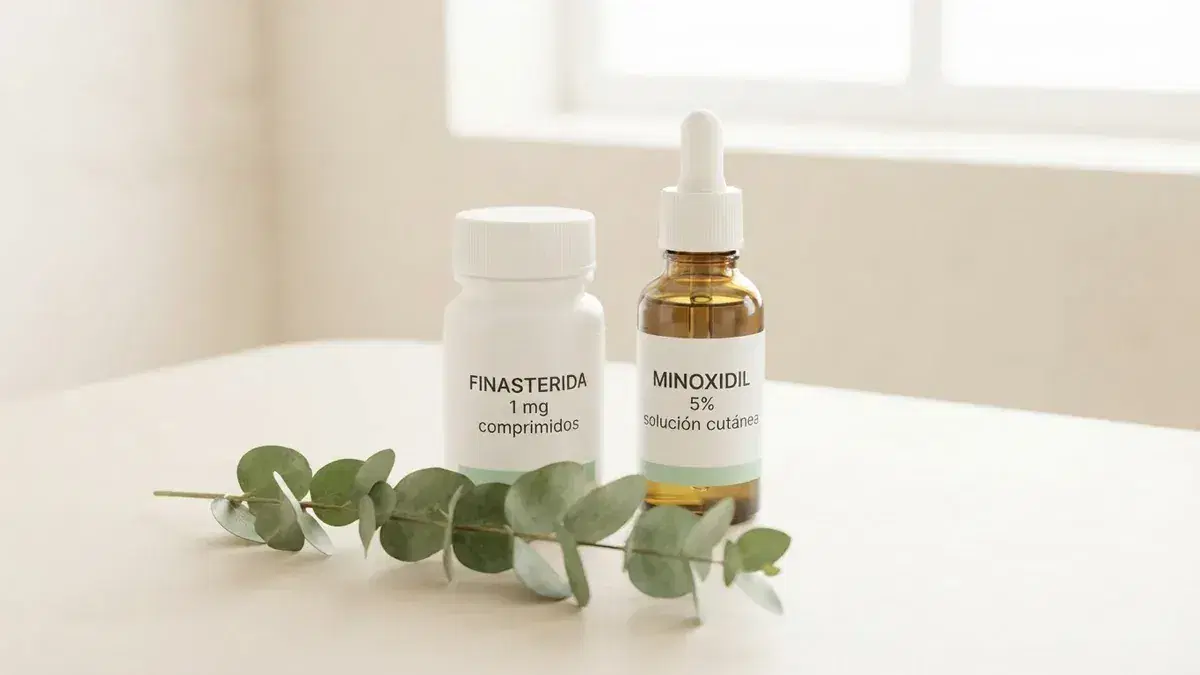
Finasteride works by blocking the enzyme 5-alpha reductase, which converts testosterone into dihydrotestosterone (DHT). DHT is the primary hormone responsible for shrinking hair follicles and causing male pattern baldness, especially when amplified by anabolic steroid use. By lowering DHT levels, Finasteride helps to slow down hair loss and can even promote regrowth of existing hair. It does not grow new hair where follicles have completely died.
Minoxidil is a topical solution that stimulates hair growth by increasing blood flow to the hair follicles. This delivers more nutrients and oxygen, promoting the anagen (growth) phase of the hair cycle. Minoxidil can help thicken existing hair and encourage new hair growth, but it does not address the hormonal cause of hair loss like Finasteride does. Both medications require consistent, long-term use for results, which typically become noticeable after 3-6 months.
Side effects and when to stop
Like all medications, Finasteride and Minoxidil can have side effects. It's important to be aware of these and discuss any concerns with your doctor.
- Finasteride: Possible side effects include decreased libido, erectile dysfunction, and ejaculatory dysfunction. These are rare and usually reversible if you stop taking the medication. In very rare cases, mood changes or breast tenderness can occur. If you experience any severe or persistent side effects, stop taking Finasteride and consult a doctor immediately.
- Minoxidil: Common side effects are usually localized to the scalp, such as irritation, itching, dryness, or flaking. Some users may experience unwanted hair growth on other parts of the body if the solution drips. If you notice severe scalp irritation, chest pain, rapid heartbeat, dizziness, or swelling in your hands or feet, stop using Minoxidil and seek medical advice.
Always follow your doctor's instructions and report any unusual symptoms during your treatment.
Why Hi-Doctor vs. walking into a clinic
Getting a prescription for hair loss treatment through Hi-Doctor offers significant advantages over traditional clinic visits:
- Speed: Get your electronic prescription in under 24 hours. No waiting weeks for an appointment.
- Price: €45 every 90 days or €35 one-off for the online consultation. No hidden fees, no variable private clinic costs. Plus, a money-back guarantee if treatment isn't suitable.
- Privacy: Everything happens within your secure Hi-Doctor account. No awkward conversations at a reception desk or in a waiting room. Your data is RGPD-compliant.
- Convenience: Complete your consultation from anywhere, anytime, using your phone or computer. No travel, no time off work.
- Trust: Join over 50,000 satisfied patients. We boast a 4.8 Trustpilot rating, reflecting our commitment to patient care and efficiency.
COMMON QUESTIONS
Frequently asked questions
If the EU-licensed doctor determines that Finasteride or Minoxidil is not appropriate or safe for you, your consultation fee is refunded automatically. You pay nothing if the treatment isn't approved.