Hair growth8 minute read
Hair Loss in Women: Causes, Diagnosis, and Treatment Options
Struggling with hair loss? Get an online consultation with an EU-licensed doctor for hair loss treatment prescriptions. Hi-Doctor offers a consultation for €45/90 days or €35 one-off with a money-back guarantee, a prescription in under 2…

DIRECT ANSWER
An online consultation lets a doctor licensed in Spain review your case and, if appropriate, issue a prescription in Spain; each pharmacy decides whether it can dispense it.
Doctor reply in under 2 hours
Average doctor reply under 2 hours; at night and on public holidays it can take longer, always within 24 hours. A prescription only if appropriate.
Doctors licensed in Spain
Every case is reviewed by a doctor licensed in Spain.
Issued in Spain
Each pharmacy decides whether it can dispense an approved prescription; outside Spain, some do not accept PDF prescriptions.
Are you a woman experiencing hair loss and looking for effective treatment? You can get a prescription for proven hair loss medications like minoxidil, finasteride, or dutasteride online from an EU-licensed doctor. Hi-Doctor makes it simple: an online consultation for €45 every 90 days (cancel anytime) or €35 one-off, a prescription in under 24 hours if appropriate, and a money-back guarantee if treatment isn't suitable. Your prescription is valid at any pharmacy across the EU.
How it works: get your hair loss treatment prescription in 4 steps
- Fill the online medical questionnaire (2–3 minutes) and pay the consultation fee of €45 every 90 days or €35 one-off.
- A licensed EU doctor reviews your case in private. If the doctor determines the treatment is not appropriate for you, your payment is refunded automatically, so there is no risk.
- If approved, you receive a valid electronic prescription (PDF file) in your Hi-Doctor account and by email within 24 hours.
- Print the PDF or show it on your phone and present it at any pharmacy in the EU (Spain, Portugal, Italy, France, Germany, Netherlands, Belgium, Austria, Ireland, etc.) to collect your medication.
Who qualifies for hair loss treatment
Our EU-licensed doctors review each case individually. They look for specific criteria to ensure the treatment is safe and effective for you. Generally, eligibility for medications like minoxidil, finasteride, or dutasteride for female hair loss depends on the type and cause of your hair loss, your medical history, and current health status.
- Female Pattern Hair Loss (FPHL): These medications are primarily used for androgenetic alopecia, where hair follicles are sensitive to androgens.
- Medical History Review: The doctor will assess any underlying health conditions, allergies, and other medications you are taking to prevent adverse interactions.
- Contraindications: Certain conditions, such as pregnancy or breastfeeding, severe liver issues, or specific cardiovascular problems, may make these treatments unsuitable. For example, oral finasteride and dutasteride are contraindicated in women of childbearing age due to potential risks to a male fetus.
The doctor will determine if the treatment is appropriate based on your questionnaire and medical history. If not, you get your money back.
What hair loss medications actually do (and don't do)
Hair loss medications work in different ways to slow hair loss and promote regrowth. Understanding their mechanisms helps set realistic expectations:
-
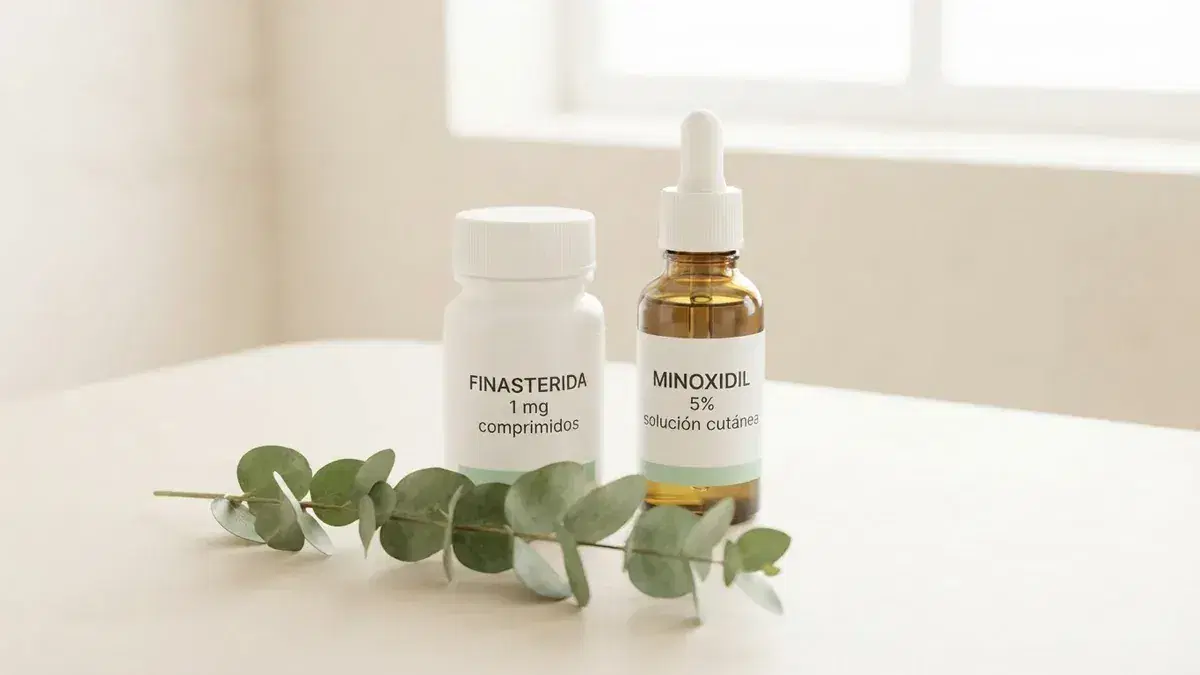
Minoxidil (Topical or Oral): This medication works by increasing blood flow to the hair follicles, extending the hair's growth phase (anagen), and encouraging thicker hair strands. It doesn't block hormones but directly stimulates the follicle. You can expect to see initial results in 3-6 months, with full effects potentially taking 12 months or more. It is most effective for diffuse thinning.
-
Finasteride (Oral or Topical): Primarily used for men, low-dose oral finasteride is sometimes prescribed off-label for post-menopausal women with FPHL. It works by inhibiting the enzyme 5-alpha-reductase, which converts testosterone to dihydrotestosterone (DHT), a hormone that shrinks hair follicles. By reducing DHT, it can stabilize hair loss and promote regrowth. Results typically appear within 6-12 months. It does not treat all types of hair loss.
-
Dutasteride (Oral or Topical): Similar to finasteride but more potent, dutasteride inhibits both types of 5-alpha-reductase. It is used off-label for FPHL in some cases, particularly when finasteride has been ineffective. It works by significantly reducing DHT levels. Due to its potency, it may offer more robust results but also carries a higher risk of side effects, and like finasteride, is contraindicated in women of childbearing age.
-
Anti-Androgens (e.g., Spironolactone): These medications block androgen receptors or reduce androgen production. They are particularly beneficial for women whose hair loss is linked to high androgen levels, such as those with Polycystic Ovary Syndrome (PCOS). They can reduce shedding and promote regrowth over several months.
These treatments require consistent use to maintain results. Stopping treatment often leads to a reversal of benefits.
Side effects and when to stop
Like all medications, hair loss treatments can have side effects. Your doctor will discuss these with you during the consultation.
-
Minoxidil: Common side effects include scalp irritation, itching, and dryness. Less commonly, unwanted facial hair growth can occur, especially with higher doses or improper application. Oral minoxidil (used off-label) can cause more systemic effects like fluid retention, dizziness, or rapid heartbeat. Stop if you experience chest pain, fainting, or severe swelling.
-
Finasteride and Dutasteride: These medications can cause hormonal side effects, including mood changes, decreased libido, and breast tenderness. They are strictly contraindicated in women of childbearing potential due to the risk of birth defects in male fetuses. If you are pregnant, planning to become pregnant, or breastfeeding, you must not use these medications. Stop immediately and consult a doctor if you become pregnant or experience severe mood changes.
-
Spironolactone: Side effects can include dizziness, fatigue, increased urination, and menstrual irregularities. It can also affect electrolyte levels. Stop and seek medical advice if you experience severe dizziness, muscle weakness, or irregular heartbeats.
Always follow your doctor's instructions and report any concerning side effects immediately. If the side effects outweigh the benefits, your doctor may advise you to stop treatment or switch to an alternative.
Why Hi-Doctor vs. walking into a clinic
Choosing Hi-Doctor for your hair loss consultation offers significant advantages over traditional in-person clinic visits:
- Speed: Get your prescription in under 24 hours from an EU-licensed doctor, compared to waiting weeks for an appointment at a physical clinic.
- Price: A consultation fee of €45 every 90 days or €35 one-off with a money-back guarantee if treatment isn't suitable. No hidden costs, unlike variable private clinic fees.
- Privacy: Everything happens securely within our RGPD-compliant app. No waiting rooms, no reception desks, just discreet online care.
- Convenience: Consult from anywhere, at any time, using your phone or computer. No travel, no parking, no time off work.
- Trust: Join over 50,000 satisfied patients. We boast a 4.8 Trustpilot rating, reflecting our commitment to quality and patient care.
- EU-Wide Validity: Your electronic prescription is valid at any pharmacy in the EU, giving you unparalleled flexibility.
COMMON QUESTIONS
Frequently asked questions
If the EU-licensed doctor determines that the hair loss treatment is not appropriate for your specific case, the consultation fee is refunded automatically. You pay nothing if the treatment isn't approved.